The fact that Liverpool has had the foresight to stage such a complex display of public art/street theatre, further highlights to me that it can and should continue to compete with the best of them. With more and more tourist destinations pushing the boundaries to attract visitors, it is clear that Liverpool has grabbed a well earned place in that list. It's no wonder Liverpool was awarded Capital of Culture in 2008. Despite years of neglect, Liverpool has pulled its socks up and the city has benefited from well thought out regeneration attempts, particularly in the city centre and around the Albert Dock. The emphasis on green, empty spaces is something the likes of Manchester should take note of, where in place of gardens and parks more and more blocks of flats continue to be built and sadly lie empty.
The most recent feather in Liverpool's cap is the Sea Odyssey Giant Spectacular. A three day event that took place between April 20-22nd in the city centre and North Liverpool, an area that has suffered economically for years. Having read and heard a lot about this 'Little Girl Giant', I was intrigued and decided to head over to Liverpool on the Sunday for the culmination of the event. I was astounded at the sheer number of people who had turned out to support the event, there were huge crowds and although difficult to find a good viewing spot for fear of squashing little children, I love that the event brought the community together to share in such a memorable occasion. I found a good spot on the Pier Head and waited for the three marionettes, a 50ft diver, 30ft 'little' girl and a 9ft dog, called Xolo, to float past on the Mersey.
The Sea Odyssey was inspired by a letter a young girl posted to her father in 1912 when he was a steward on the Titanic. Sadly, the letter was never delivered. A French street theatre company, Royal De Luxe, created the remarkable story, rather like a fairytale, of a giant who died on the Titanic, his orphaned little girl giant, the diver uncle and a giant dog. The whole concept is such a unique and unusual way for Liverpool to mark its links with the Titanic, 100 years after the ship sank to the depths of the Atlantic, taking with her those 1,512 passengers who sadly perished. The Sea Odyssey is a fitting tribute and a inspiring way for children as well as those who don't know much about the Titanic, to develop an understanding of what happened on 14th April 1912 and the legacy she has left behind.
Aside from the cultural impact the Giants will have on Liverpool, the event, which cost £1.5m, has boosted the local economy by at least £12m according to Liverpool City Council. Over 500,000 people visited the city to see the little girl, her pet dog and diver uncle wander through the streets of Liverpool with a wonderful backdrop of some of Liverpool's most beautiful buildings. I wonder what Liverpool will think of next? I will leave you with the story of the Giants:
The Sea of Liverpool has swallowed up so many sailors, travellers and adventurers that you would think it was a cannibal.
Icebergs are boat hunters and Liverpudlians are huge children with eyes full of hope and rebellion.
For the unsinkable Titanic, her first voyage was also to be her last.
But let's move right away to the story of one stowaway: loaded on board during the night, unnoticed - a thirty foot tall Giant capable of travelling through time, on his way to another continent to meet his daughter, the Little Giant.
Giants don't grow old, don't grow up, they just stay the age they are for eternity - that is, if they don't die. Disaster struck in the Atlantic Ocean; everyone knows the details of the accident. The ocean liner was the pride of Liverpool, and many different Liverpudlian tradesmen were recruited, mainly to maintain the ship and to look after the passengers.
But let's return to our gigantic passenger trapped in one of the holds. He feels the full force of the iceberg's blade. The sea rushes into the ship so fiercely that he is unable to move.
He is a prisoner and plummets 12,000 feet with the Titanic. We believe that, knowing he would soon die, he took his last underwater lift ride before coming to rest in a cloud of dust on the ocean bed.
Above, petrified with fear, survivors hoped for miracles - some were rescued, that too is known.
When the Little Giant heard the news, she sought out her uncle, the Great Giant's brother. While listening to her, the uncle made a decision that was to take him a century to carry out.
First, he would make himself a diving suit. Then he would scour the ocean floor for the shipwreck. After that, he would bury his brother in the deep-sea bed. Most importantly, he would come back with the letter the Great Giant had written to the Little Giant Girl. This is why he walked for many long years across the ocean floor, pulling the Titanic's mail trunk to bring back the post to Liverpool.
Such tragedies do not affect the Little Giant's morale who bravely decided to come to the reunion. While reading magazines before leaving, she discovered that there are another two famed legends in Liverpool - The Beatles music, and the sheer madness for football of the rebel City.
Before setting up her first camp in Stanley Park, between the two football stadiums north of the city, she decides she will go on a cruise through the town on a road-sailing boat. A few hours before her arrival, as if by magic, a geyser shoots up from the ground in the city centre, to herald her arrival." Story written by Jean-Luc Courcoult, Author, Artistic Director and Founder, Royal De Luxe.
Stanage Edge, Peak District There's nothing quite like a long, leisurely walk in the countryside, is there? Breathing in all that clean, fresh air and feeling that all that walking is 'good for you'. My recent trip to Stanage Edge, a 4 mile long gritstone cliff overlooking Hathersage in the Peak District was exhilarating but perhaps for all the wrong reasons! The day started off with blue skies and sunshine and us following the map correctly. Unfortunately as the day went on, the sky grew darker, the wind grew stronger and the hail and snow arrived - meanwhile we had become sure that the OS map was wrong (always a mistake - since the map NEVER lies!) Whilst the weather could have been better, it certainly didn't dampen our spirits. The views across the heather laden moorland reminded me how lucky we are to have such beautiful places in such easy reach! There's something quite exciting about walking on Stanage Edge during the winter. There's not a lot of people about which makes the views across the Hope valley just that little bit more special, knowing that you don't have to share them with anyone else!
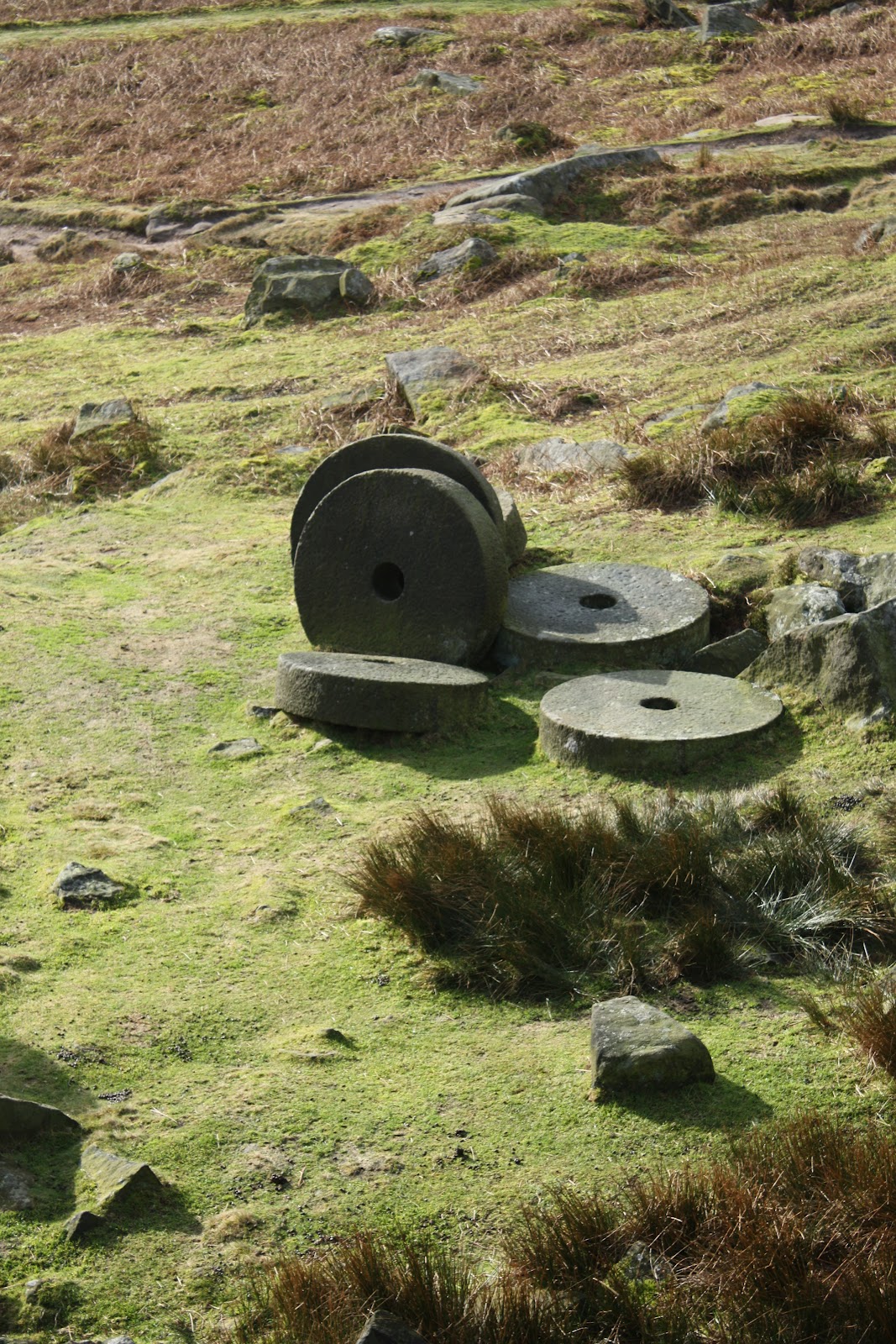
As we reached the summit of Stanage Edge (458m) I only had to glance over the edge to see a picture perfect image of history - the abandoned millstones scattered around the area that have formed part of the landscape since the 19th century. The nearby village of Hathersage was once an important area for quarrying stones. They were used for grinding corn and metals in mills and later for the production of needles and pins, which Hathersage became famous for. It's sad to think of the grinders who had an average life expectancy of just 30 due to the fragments of dust and steel that entered their lungs.IT was also not uncommon for the gritstone wheel to shatter as it was rotating, causing injury to the grinder.
North Lees Estate Walking from Hathersage towards Stanage Edge, we came across North Lees Hall, an Elizabethan manor house. It is said that it was the inspiration for Thornfield Hall in Charlotte Bronte's Jane Eyre after she stayed in the area in 1845. The Hall has since been used in Pride and Prejudice (2005) and the BBC's production of Jane Eyre (2006).
Getting to Hathersage & Stanage Edge
Hathersage is situated in the Derwent Valley, Derbyshire (in the Peak District). There is a train station at Hathersage and from there you can do the 9 mile walk to Stanage Edge and back. Be sure to stop off at the quaint Cintra's Tearooms in Hathersage for a hot cup of tea and a warm scone on your return - especially if you get soaked by the rain, hail or snow during your walk!
Click here for directions for the 9 mile walk from Visit Peak District - On the Edge at Stanage...Enjoy!
Consider what you see and hear around you, and use your voices to Speak Upagainst hatred and discrimination.
Holocaust Memorial Day 27-01-2012
Arbeit Macht Frei "Work Brings Freedom"
When I think of the Holocaust, the first thing that comes into my head is the number '6 million'. In all the books I've read and films I've watched about the holocaust, that number has stuck in my head. Such an enormous figure is hard to imagine when I think of it in terms of people - men, women and children. 6 million people murdered in concentration and extermination camps, ghettos and mass-shootings. Hitler's regime murdered Jews from countries all over Europe as well as physically and mentally disabled people, homosexuals, gypsies, political prisoners and those involved in resistance movements.
Why this day?
Holocaust Memorial Day takes place on 27th January because it was on this day in 1945 that Soviet soldiers liberated Auschwitz-Birkenau - the largest Nazi killing camp. Here, 1.1 million people were murdered. Holocaust Memorial Day is one day in the year when we can reflect on our lives and think about those 6 million people who lost their lives as a result of Nazi persecution. It is also a day when we can spare a thought for those who lost their lives or whose lives were altered forever in subsequent genocides in Cambodia, Rwanda, Bosnia and Darfur.
My Experience of Auschwitz I and Auschwitz II- Birkenau
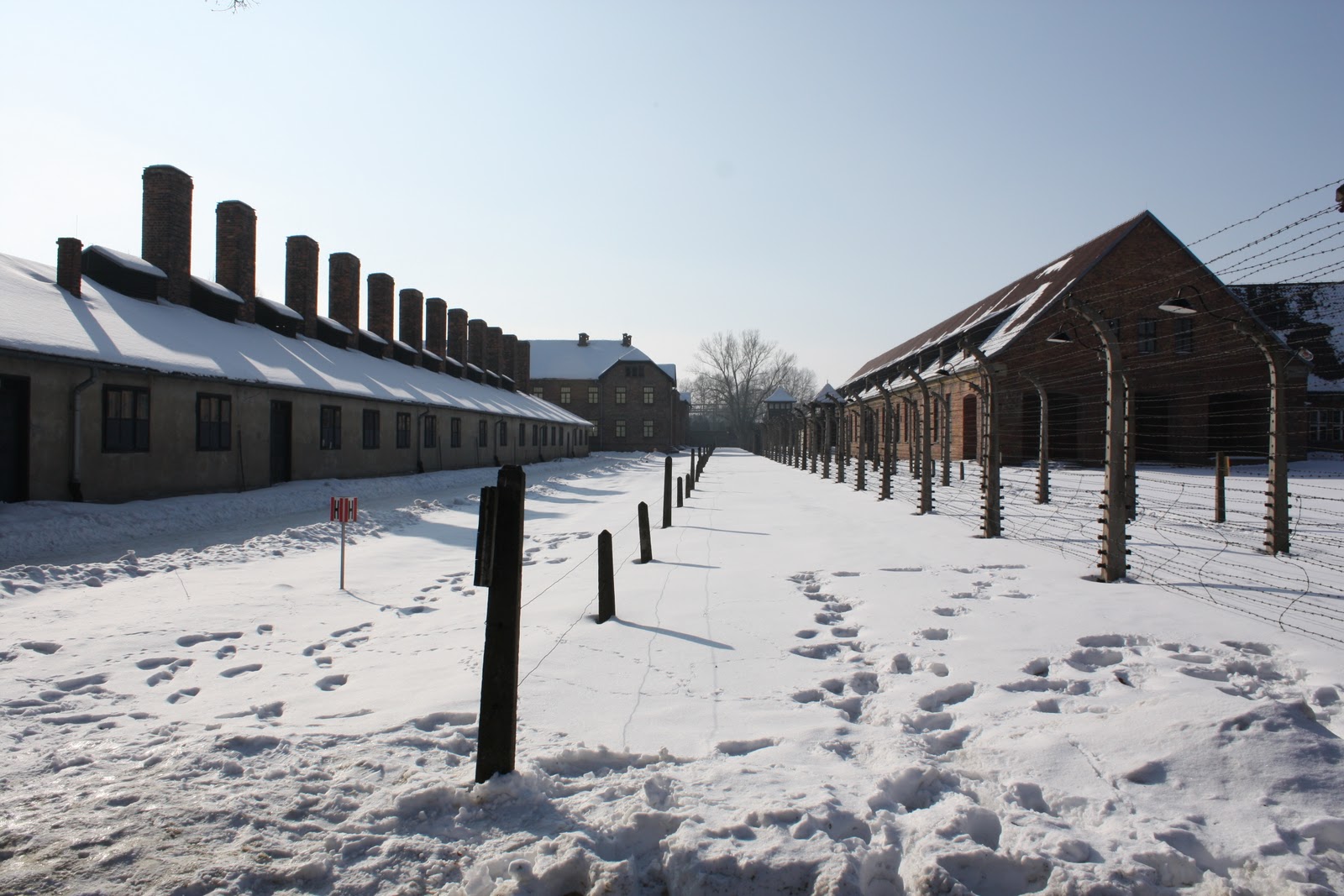
I visited Auschwitz during winter. I crunched around in the snow until I got to the gated entrance to Auschwitz where I felt quite awkward watching the sheer number of tourists about to embark on group tours. I immediately separated myself from them, trying to rid myself of the idea that Auschwitz was some kind of tourist attraction. But thinking about it now, I suppose it is. The fact that so many people come from all over the world daily to visit this 'attraction' shows us the enormous impact it has had the world over. Having seen it with my own eyes, I feel particularly strongly that everyone who has the means should visit Auschwitz or another Nazi camp at some point in their lives. Auschwitz I is a maze of camp blocks and barracks, all surrounded by barbed wire and overlooked by giant guard towers. It was originally a Polish military camp but when the Nazis came they turned it into a prisoners camp. Scull and cross bone signs dug into the ground threaten those who dare to wander too close to the barbed wire to 'Halt!' It was here that the first Auschwitz camps were opened and where they tested the lethal Zyklon-B (used in the gas chambers to kill people). It was also here where the Nazis conducted experiments on prisoners and carried out executions. Several of the blocks are open to the public and as you walk into each room you are surrounded by floor to ceiling huge collections of personal possessions from those who came to Auschwitz. Among the items were 3,800 suitcases, 40 kg of glasses and 110,000 shoes. One room held two tons of human hair. These rooms were probably the most moving and as you can imagine, it was an emotional experience.
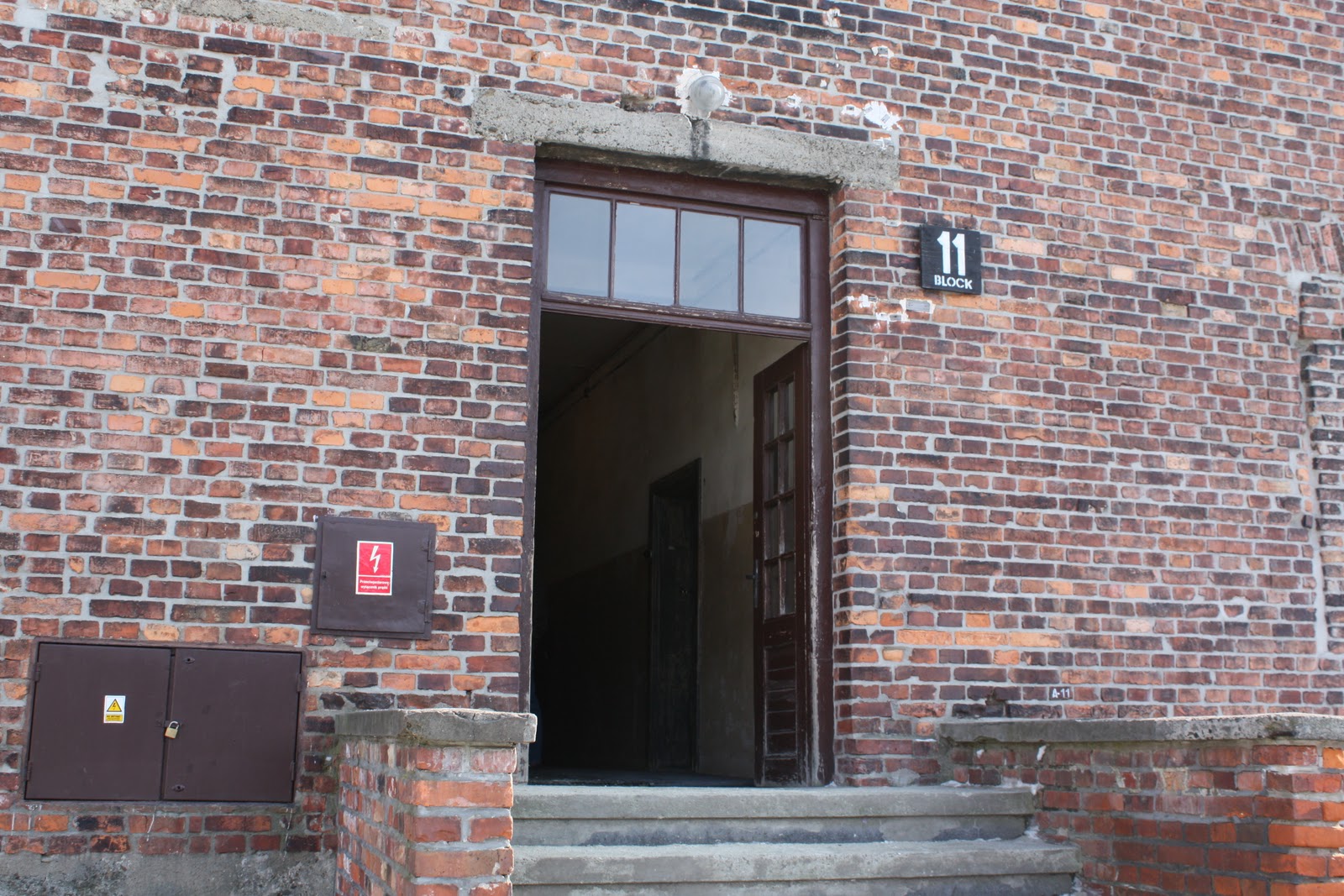
Block 11 - The Death Block
Block 11 was known as the 'Death Block'. It was here that prisoners suspected by the camp gestapo of carrying out clandestine activities were held (attempting to escape/organising mutinies/contact with outside world). They were generally brutally interrogated before being shot. For a time this block also held the Sonderkommando (the special unit of prisoners who were forced to burn bodies). Going down into the basement, I saw four standing punishment cells so small (1 square metre each) that it was hard not to visualise four prisoners confined in each cell for the night before having to go to work in the morning. The only source of air was a 5 x 5cm opening covered with a piece of metal. There were also dark cells which prisoners were confined to for days or even weeks, this was the way the SS put people to death by starvation. The SS carried out an experiment here with Zyklon-B which led to the mass killing of thousands of people in the gas chambers. Between 3-5th September in 1941 600 Soviet POWs and 250 Polish political prisoners were selected from the camp infirmary to act as guinea pigs.
'Death Wall' in the walled-off yard of block 11
'Death Wall' - It was here that a firing squad would shoot prisoners.
Camp blocks
Barbed wire fence
"The first to perish were the children, abandoned orphans, The World's best, the bleak earth's brightest. These children from the orphanages might have been our comfort. From these sad, mute, bleak faces our new dawn might have risen"
(Auschwitz Birkenau)
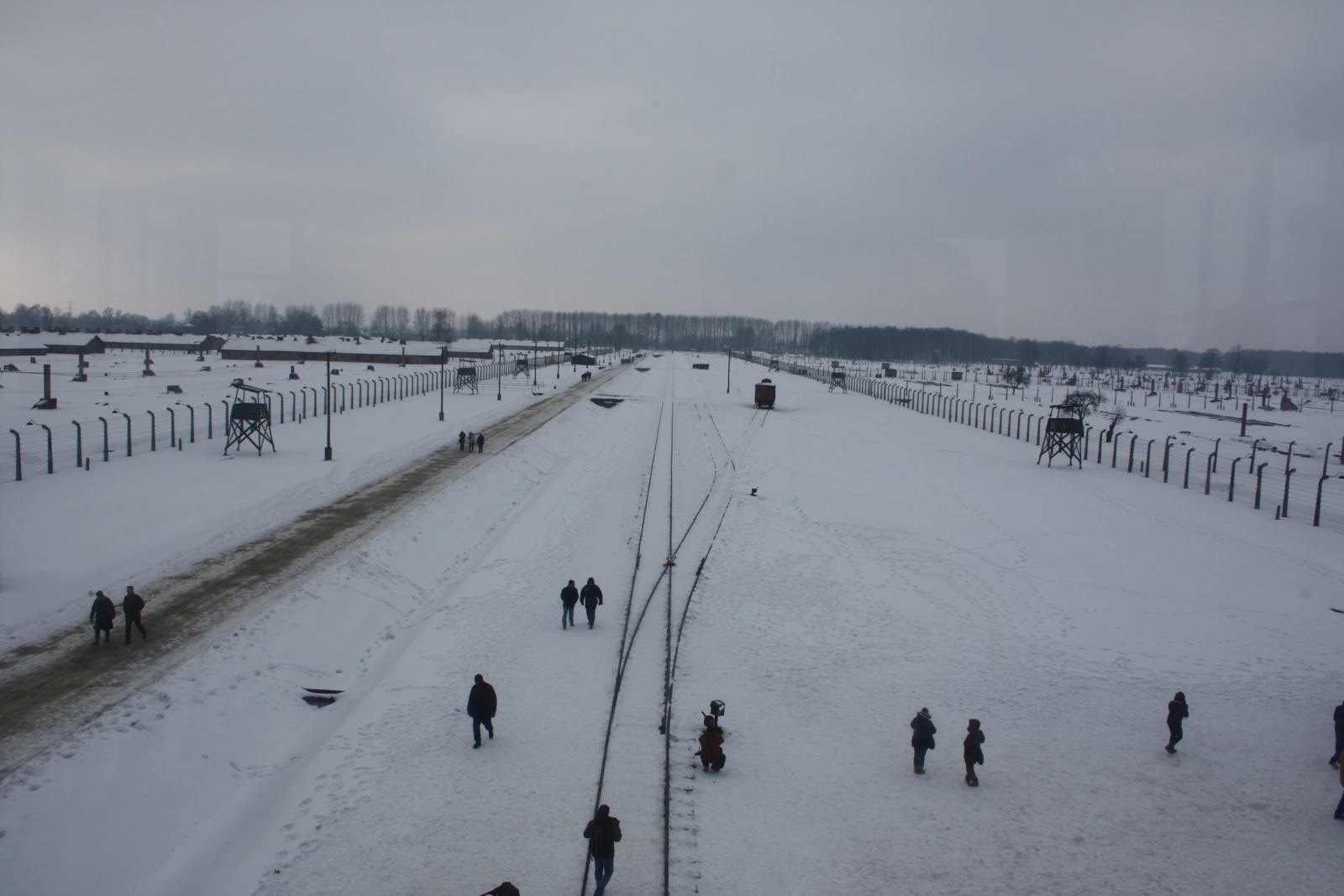
Deportations arrived by train
A short bus or taxi ride away lies the remains of Auschwitz-Birkenau. At this camp, approximately one million European Jews were murdered. In 1944 over 100,000 prisoners (Jews, Poles, Roma and others) were here, housed in 300 wooden barracks. The camp holds the ruins of the gas chambers and crematoria. My experience here was somewhat different. It was a vast expanse of space (200 hectares of grounds), blanketed in thick snow from the bitter Polish winter. The cold seemed to penetrate through six layers of clothes and three pairs of socks to reach my bones. All I could think about was how perishing the cold was (-10), and how prisoners were made to walk around in freezing temperatures wearing next to nothing.
Auschwitz-Birkenau
After a while, the people drift away, the coaches drive away and all that is left is the sound of the icy air whizzing past you and the feeling that you are not alone. It was eerie, bleak and when I realised I was the last person left, somewhat terrifying. However, though it may sound strange, it was one of the most peaceful moments in time I have ever experienced. It was pure stillness. Nothing moved, nothing sounded - not even the birds.
I may be just one person out of millions who have visited Auschwitz, and I probably had a similar experience to others but I feel I took away something unique - something I haven't got from reading books about the Holocaust. And that is hope. Hope that by people, young and old, coming to Auschwitz and seeing with their own eyes the atrocities that were carried out here, it will give us a truer understanding of what human beings are capable of in extreme situations. Hatred and discrimination for whatever reason should never be tolerated under any circumstances. This message written on a plaque at Auschwitz-Birkenau sums up the way I feel perfectly:
"For ever let this place be a cry of despair. And a warning to humanity. Where the Nazis murdered about one a half million men, women and children, mainly Jews from various countries of Europe".
"I swore never to be silent whenever human beings endure suffering and humiliation. We must always take sides. Neutrality helps the oppressor, never the victim. Silence encourages the tormentor, never the tormented".Elie Wiesel, Holocaust survivor.
Make a pledge now to challenge the language of hatred and commit to using words which reflect respect for the dignity of those around you.
The perfect place to get some inspiration for holidays in 2012 and beat those winter blues! The show will feature a range of exhibitors, celebrity speakers, explorers, historians and news correspondents. There will also be a range of cultural performances taking place on the Entertainment Stage.
The Manchester show will host performances from Manchester School of Samba, Red Fan Chinese Dance Society as well as African drumming and Egyptian, Ukrainian, Cuban and Punjabi dancing. In addition, Tropical Inc will be bringing along a selection of animals including meerkats, skunks, snakes and macaws!
It's disappointing that whilst there are no fewer than 13 celebrity speakers, explorers, historians and news correspondents booked for the London show as well as the Amateur Photographer Travel Photography Theatre; there are only 4 speakers and no photography theatre for the Manchester show. Alas, us folk up north will have to make do with what we've got...perhaps Sir Trevor McDonald OBE and others will make the journey up to Manchester next year...
If you're a Manchester Confidential reader you can claim free tickets. Lonely Planet magazine readers can also pick up free tickets in this month's edition.
2012: A New Year...A Time for Resolutions! Well, maybe for some. I myself haven’t bothered to go as far as making any new
year’s resolutions as I can’t think of a reason why I would want to make myself
miserable or disappointed in a few weeks or months time when I fail to keep
them. A New Year is just another year in our lives and we can make it a good year or an even better year than the last; or we can just continue the way we were at one minute to 12 on New Year’s Eve, thus eliminating any unnecessary pressure we might be about to put on ourselves.
When I hear people say things like ‘I’m glad that year’s over and done
with, bring on the next’ it makes me quite sad because I for one would rather
not wipe the previous year off the table and forget it in its entirety. Even if
it was the ‘worst’ year in the history of the world, surely we can always find something
that was good, that made us happy and that is worth holding onto.
So for 2012, instead of resolutions, I pledge to enjoy it as
much as I can and be as happy as I can for myself and others– even in the face
of adversity, setbacks and challenges that may come my way. So let’s break open the champers and have a
bloody good year!
January may still be cold but to prevent hibernation, wrap up warm & head outside for a wintry walk...certain to take away those winter blues!
7 years and 354 days, 2,500 men, 53,000 tonnes of steel...
"Every day those men went onto the Bridge, they went the same way as a soldier goes into battle, not knowing whether they would come down alive or not." (Lawrence Ennis, Director of Construction, 1932).
"Life Down Under"
It was dark; I hadn't long arrived and I wasn't quite sure where I was when I caught my first glimpse of Sydney. I climbed up a few steps to see the city lit up against the dark, night sky with not a single person around. In my travels, I've often found that the best views are just stumbled upon by chance when the guide book is packed away in your bag. Inside I was bursting with excitement to see the Sydney Harbour Bridge, but at that moment I was content at taking in the view of the skyscrapers from afar and trying to believe my luck at being in a city I'd dreamed of visiting.
"Under the Bridge"
The next day, I went straight to the Bridge, or the 'Coathanger' as it is also known. It was no ordinary coathanger, that's for sure. There are several places that give terrific views of the Bridge, but the first time I saw it was from The Rocks - an area steeped in historic charm. The Bridge looked majestic in size and beauty and I was surprised to see Sydneysiders taking the ferry to work. Now that is what I call commuting in style!
A Symbol of Australia Recognised the world over, climbed by 'adrenaline junkies' and photographed by tourists from every nation, the Sydney Harbour Bridge has become a symbol of Australia. More often than not the only images we have in our minds of the Bridge come from glossy holiday brochures and TV programmes promising families a 'better way of life' if they opt to move Down under. Whilst those images have the power to excite even the most unadventurous people, they are just part of a glossy exterior. The Bridge represents the achievement of boiler makers, carpenters, engineers, ironworkers, blacksmiths, painters, electricians, riggers, stonemasons and countless others - many of whom came from Britain. It represents the 800 families who were relocated because they fell in the path of the Bridge. It represents the homes of those 800 families that were demolished with no compensation given to the families. And it represents the sixteen workers who lost their lives during the construction of the Bridge. In October 1929, five years into the construction of the Bridge, the Wall street stock market crashed. The hard times that followed were eased for workers on the Bridge. Individual working hours were reduced to take on more men. The Bridge became aptly nicknamed, 'The Iron Lung' .
"Where Nerve is Needed"...
The sixteen men who died in the construction of the Bridge were rightly recognised and to this day remembered. What should also be remembered is the effects building the bridge had on its workers. Painters regularly suffered from swollen limbs, dizziness and sickness as a result of the 'Bridge Grey' lead-based paints that were thought to provide the best surface cover for the Bridge. Engineers coped with working inside the dark chords with a lack of oxygen; whist dealing with hot and cold/damp steel in summer and winter respectively. Workers outside had to put up with the rain, wind and Australian heat. Sadly, many workers went deaf in later life.
19th March 1932: 750,000 of Sydney's 1 million population came to celebrate the opening of the Sydney Harbour Bridge. Today it is still a place where people gather in celebration: most recently to bring in the New Year, 2012.
"Today is the day of days, when political differences are forgotten. New South Wales unites in the glorification of Our Bridge, and added attraction to Our Harbour. The building of this gigantic Bridge is just as much a national milestone as Anzac." (Source: Labor Daily, 1932).
Top 5 Facts 1. It took 272,000 litres of paint to give the Bridge its initial three coats. 2. It took approximately 6,000,000 rivets, the largest weighing 3.5kg. 3. The pylons are 89 metres above mean sea level. 4. The total weight of the steelwork is 52,800 tonnes including the arch and mild steel approach spans. 5. The length of the arch span is 503 metres. Figures obtained from the Australian Government website (Sourced from: Mackaness, C. (ed.) 2006,Bridging Sydney, Historic Houses Trust of New South Wales, Sydney)
Ever thought about spending Christmas in sunnier climates? It might not suit everyone to say farewell to turkey and stuffing and opt for a cheeky Barbie on the beach or an Aussie Christmas dinner complete with freshly caught prawns; but it is certainly something different to try. It didn't take me long to get over my fear of seafood and have a taste of
everything - including oysters!
Relaxing in Sydney
Christmas is a wonderful time to visit Sydney. With temperatures hitting the mid-30s it's a great time to relax on one of Sydney's 37 beaches. From Bondi and Coogee beach on the south side of the harbour, to Manly and Palm Beach in the north; whether it's surfing, sunbathing or snorkelling you're into, you are sure to find the perfect spot! If the beach isn't your thing, the Royal Botanical Gardens are the perfect place for a picnic, sunbathe or stroll. You may even spot a lovely summer wedding as it is quite a popular spot to tie the knot!
Royal Botanic Gardens, a truly memorable place
Shopping in Sydney
You'll be spoilt for choice if you want to do your Christmas shopping in Sydney or pick up some treats for family and friends back home. One shopping gem not to miss is the richly decorated Queen Victoria Building (QVB), built in 1898. It is filled with stained glass windows and beautiful Romanesque architecture and even has an original 19th century staircase. The giant Christmas tree below is located in the central dome and is definitely not to be missed! If it's designer fashion you're looking for, the Strand Arcade is the place to be. It is the only arcade built in Victorian Sydney left in its original form today.
Giant Christmas tree in the Queen Victoria Building
Things to see and do in Sydney If you're looking for waterfront restaurants, an IMAX cinema, aquarium or maritime museum then look no further than Darling Harbour. What used to be a dockside area, Darling Harbour has become a major tourist site. My top tip is to head to St. Moritz Chocolate Cafe and grab some Belgian waffles smothered in chocolate sauce! You may even get to see Santa and his elves surprise you by turning up on jet skis whilst you are listening to Christmas carols ...
Darling Harbour by night
St. Mary's Cathedral
Nativity scene outside St. Mary's Cathedral
Sensational Sydney
No trip to Sydney would be complete without visiting Sydney Opera House and the Sydney Harbour Bridge. It is well worth climbing the 200 stairs to the top of the Pylon Lookout for some fantastic views (it is also a lot cheaper than the Bridge Climb, though perhaps not as exhilarating). Visiting the Opera House is a real treat. Whether you go on a tour, watch a performance or just admire it from afar, it will certainly be a highlight of your trip!
 The fact that Liverpool has had the foresight to stage such a complex display of public art/street theatre, further highlights to me that it can and should continue to compete with the best of them. With more and more tourist destinations pushing the boundaries to attract visitors, it is clear that Liverpool has grabbed a well earned place in that list. It's no wonder Liverpool was awarded Capital of Culture in 2008. Despite years of neglect, Liverpool has pulled its socks up and the city has benefited from well thought out regeneration attempts, particularly in the city centre and around the Albert Dock. The emphasis on green, empty spaces is something the likes of Manchester should take note of, where in place of gardens and parks more and more blocks of flats continue to be built and sadly lie empty.